


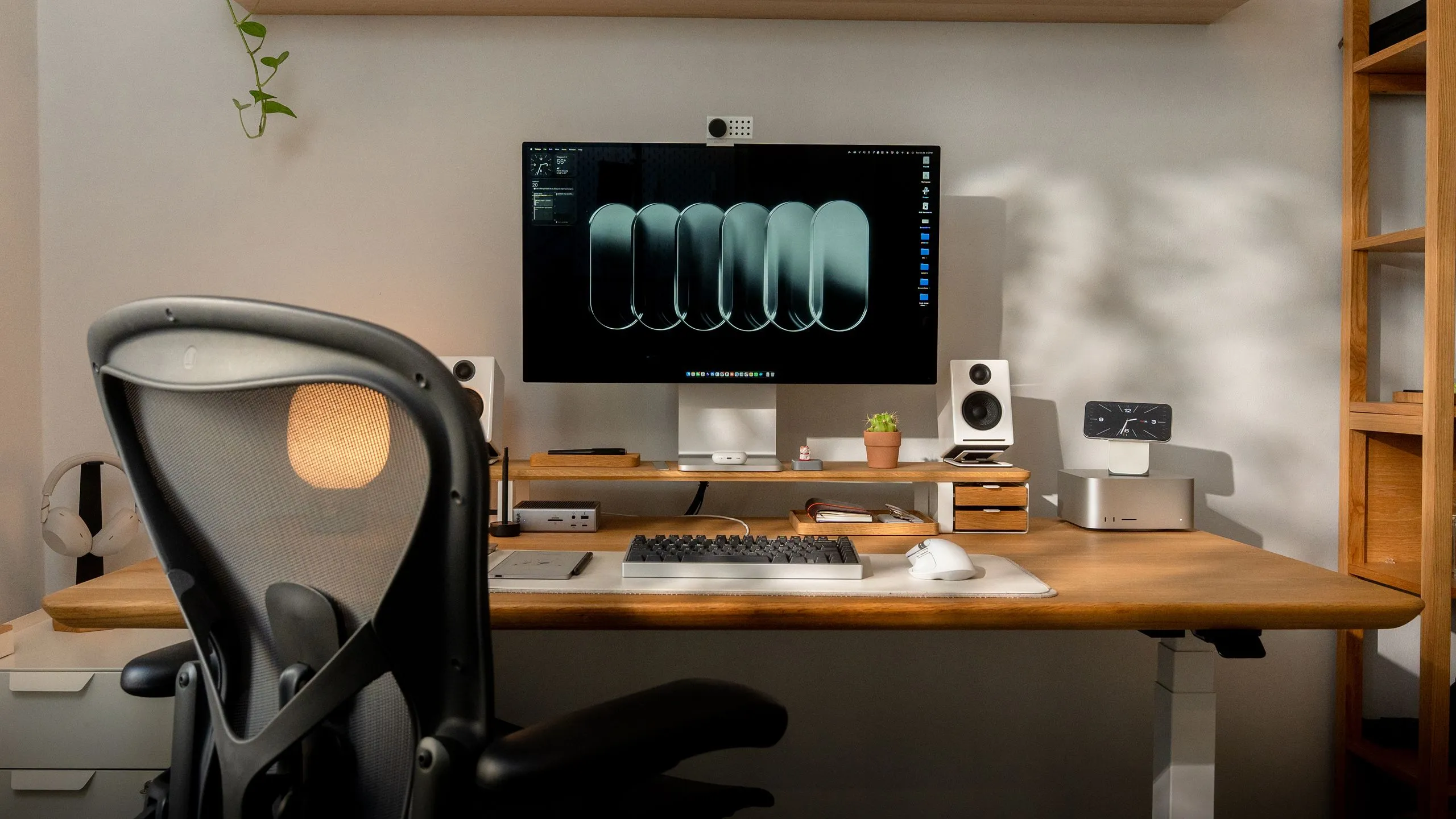
This is my studio. It’s where I spend most of my day designing, creating content and learning something new.
When I set it up, I had a few simple goals. I wanted a place where I’d enjoy working and get more done, and I wanted every item to have a clear purpose.
I’ve been building and redesigning my setups since 2018. Every year I change something that helps me focus more on the work. Here’s how the setup has changed over time.
Some links in this post are affiliate links. I earn a small commission at no extra cost to you, and I only share things I use every day.
Desk and cable management
My desk is where most of my work happens, so I wanted something minimal and well made. I’m using the Standing Desk Pro from Oakywood.
It’s solid oak, it’s quiet, and it doesn’t wobble, even with my full setup on top. I switch between sitting and standing a lot, and the Bluetooth app makes that easy. Under the desk, a cable tray hides everything. When my desk looks clean, I somehow get more done.
Chair
I’ve had the Herman Miller Aeron for almost three years, and it’s one of the biggest upgrades I’ve made. I can adjust almost everything, and even after long days, I haven’t had any back pain. For me, it was completely worth it.
Computer and dock
At the centre of my setup is the Mac Studio. It handles all my design work without slowing down, even with lots of apps open. When I’m travelling or at a café, my MacBook Pro M3 comes with me, and Dropbox keeps everything in sync.
Everything plugs into the CalDigit dock, including the monitor and webcam, so I never have to think about ports.
Monitor and webcam
The Apple Pro Display XDR was on my wishlist for almost three years. The price made me hesitate, but I look at this screen every day, so in the end I went for it. UI work looks incredibly detailed on it.
On top sits the Opal C1 webcam, which I use for client calls. After two to three years, the video still looks sharp.
Desk shelf and speakers
The Oakywood desk shelf gives me more room. The monitor and speakers sit on top, and a small drawer underneath holds my everyday bits.
My Audioengine A2+ speakers have been here for almost four years. They still sound great for their size, and I’ve never felt the need to upgrade.
Keyboard, mouse and desk mat
I never thought I’d use a mechanical keyboard until I saw the Mode Sonnet. It’s heavier than I expected, but after almost a year of typing on it, it’s hard to imagine going back.
My mouse is the Logitech MX Master 4. Compared to my old MX Master 3, it feels nicer in the hand, scrolls smoother and doesn’t get shiny spots. Both sit on an Orbitkey desk mat that protects the desk.
My Mode Sonnet configuration: silver top case, Tomorrow Tactile switches, Obscura keycaps, gold Durock V2 stabilizers and the foam kit.
Small things on the desk
The Nomad charger keeps my phone and AirPods charged without looking messy. The Audo lamp is my newest favourite. At night, I keep it on instead of the overhead lights.
Productivity tools
Since I started going back to pen and paper, my thinking feels a lot clearer. So now, when I choose my tools, I look for two things. I want them to be compact, so I can carry them anywhere easily. And I want them to feel real, so writing feels like actual writing and reading feels like actual reading.
My Paper Republic journal holds the Reef refill and a Field Notes. It’s where I slow down and think on paper. For quick notes, the Grovemade Notepad and Desk Pen stay on my desk.
I plan my day on the reMarkable Paper Pro Move and read on the Xteink X3. Both are small, and both feel close to real paper. Brick keeps me off social media, and the Sony WH-1000XM6 helps me focus when I need quiet.
Pen and paper changed how I think, and every tool here helps me keep it that way.
The studio
The desk is where most of my work happens, but I wanted the rest of the studio to feel the same way.
Behind the desk are two Skådis pegboards, with a wooden frame and an orange poster between them. When the light hits it, the frame almost looks 3D.
My old shelving started to feel limiting, so I switched to IKEA’s modular system. I tested layouts in IKEA’s planner first, and it turned out better than I expected. Now the shelves hold books, cameras and things that inspire me.
A few plants soften the space.
This is another part of my studio. When I want to write, think, plan or focus on something away from the computer, I come here. It’s also where I record videos and other things.
Other things I use
Final thoughts
I’ve been changing my setup since 2018, and this won’t be the last version. For now, it fits how I work, and it’s a place I enjoy spending my days in.
If you’re setting up your own space, make it personal. Start with what you use every day, then add the things that make you want to sit down and work.